
03 · IBM · ENTERPRISE DESIGN LEAD, CUSTOMER JOURNEY SYSTEMS · 2019–2021
From products to people: getting an enterprise to sell around its customers
IBM’s business units were organized, and rewarded, to sell what they built. I led the research that defined the goals customers were actually attempting to achieve, a data science team that turned it into a repeatable model for bundling and sequencing offerings, and the internal campaign that got business units to sell together. Then I turned the focus inward to define a system for teams to assess their own health.
1.7 → 4.3
offerings per enterprise deal
2
business units realigned around customer journeys: IoT and Supply Chain
400+
employees trained
ROLE
Enterprise Design Lead, Customer Journey Systems; R+D lead researcher
REPORTED TO
Progress and findings presented to the GM of Design and his executive leadership team
TEAM
Led 2 data scientists within cross-functional R&D teams of up to 10
SCOPE
Research strategy, journey architecture, data science, internal evangelism, enablement
PARTNERS
General managers and teams in the IoT and Supply Chain business units
THE SITUATION
Customers bought across business units to reach one goal. However, the business units had no reason or roadmap to sell that way.
Portfolios, teams and incentives were built around products. Each unit knew its own offerings and measured its own success, so no one could see a customer’s goal whole, or recommend what else would help them reach it. Changing that took evidence strong enough to convince executives, and relationships strong enough to change how units worked together.
FOUR CHAPTERS · SEEING THE CUSTOMER, THEN THE TEAM
01 · THE RESEARCH · FALL 2019
Define the handful of things most customers are trying to do
WHAT I DID
As lead researcher, I designed a three-pronged study to agree on up to ten key journeys. It balanced what executives believed about customers (inside-out) with what customer data and the voice of the customer, gathered through sales and service, showed (outside-in), so each could validate or challenge the other.
WHY IT WAS BUILT THIS WAY
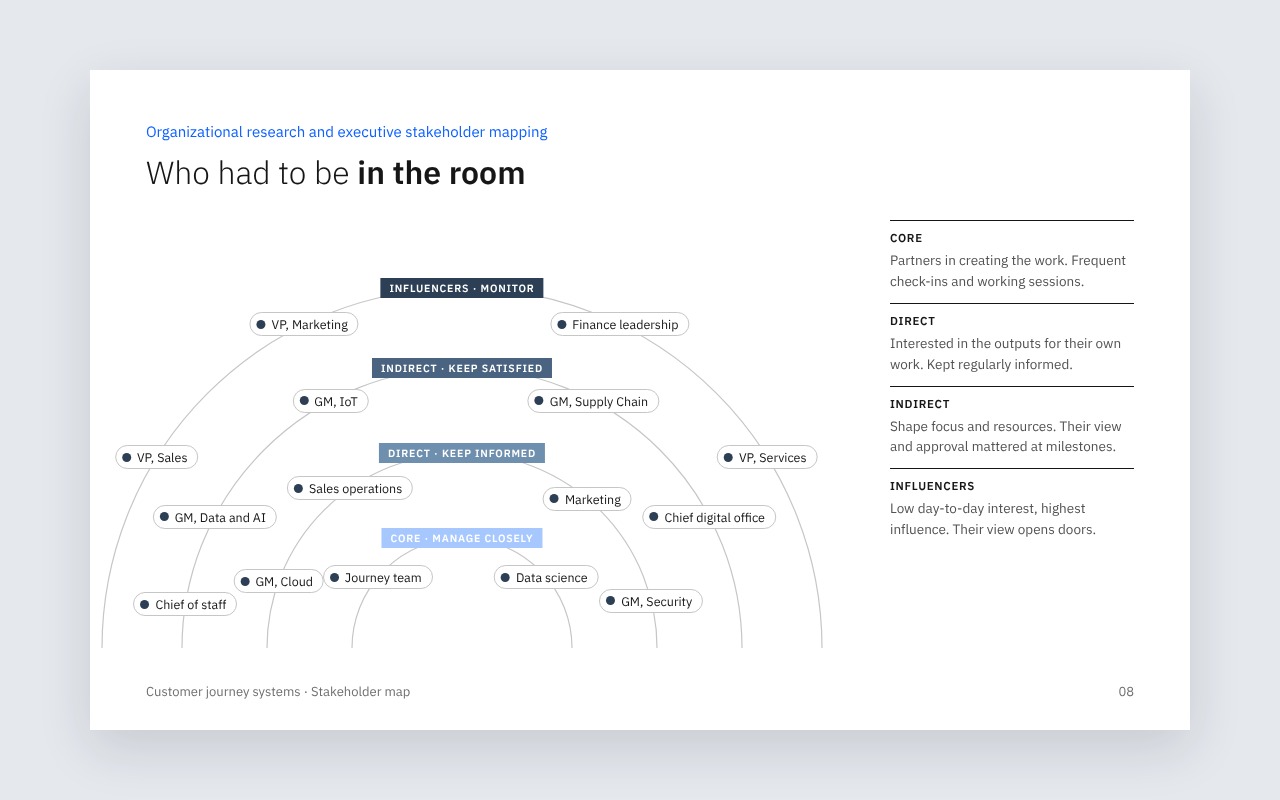
Interviewing executives from every major function first wasn’t only about gathering input. It earned their buy-in to the method before any findings existed. Collecting customer goals was the reason to build bridges across the company.
THE RESEARCH PLAN
INSIDE-OUT · QUALITATIVE
Executive interviews
15–20 one-hour interviews with follow-up reviews, across Communications, IT, HR, Support, Services, Finance, Marketing, Sales and product, so no single department’s view could skew the result.
OUTSIDE-IN · QUANTITATIVE
Twelve months of customer data
External and IBM.com search terms, web and app analytics, support requests, prior research, social and developer communities, and competitor sites, each read for the goals behind it.
OUTSIDE-IN · VOICE OF THE CUSTOMER
Through sales and service
Worked with sales and customer service to gather the goals customers voiced in their own words, across four personas: tech and business leaders and doers.
Key journeys: up to 10 goals the vast majority of customers share
Reviewed with stakeholders throughout to build consensus
Structure and scope from the Fall 2019 research plan I wrote and led.
A shared language: five stages that could be applied across the entire organization
Simple logic, made evident to several hundred thousand people
The five stages sound obvious. At IBM’s size, they weren’t. Without a shared language, sales teams pitched upgrades to customers who had just completed a purchase: an exhausting experience for customers and wasted effort for IBM.
Knowing that someone exploring a service for the first time next needs help evaluating it, not a sales pitch, is far from trivial when hundreds of thousands of people have to act on it. An organization that size needs shared mental models to work at all. The key journeys gave every unit the same one.
Explore
exploring a high-level topic
Evaluate
deciding if an offering fits
Embrace
committing resources to IBM
Extend
deepening or upgrading
Expand
buying more, referring others
THE RIGHT NEXT STEP
After Explore, give customers what they need to Evaluate: comparisons, trials, proof.
THE MISSTEP IT PREVENTED
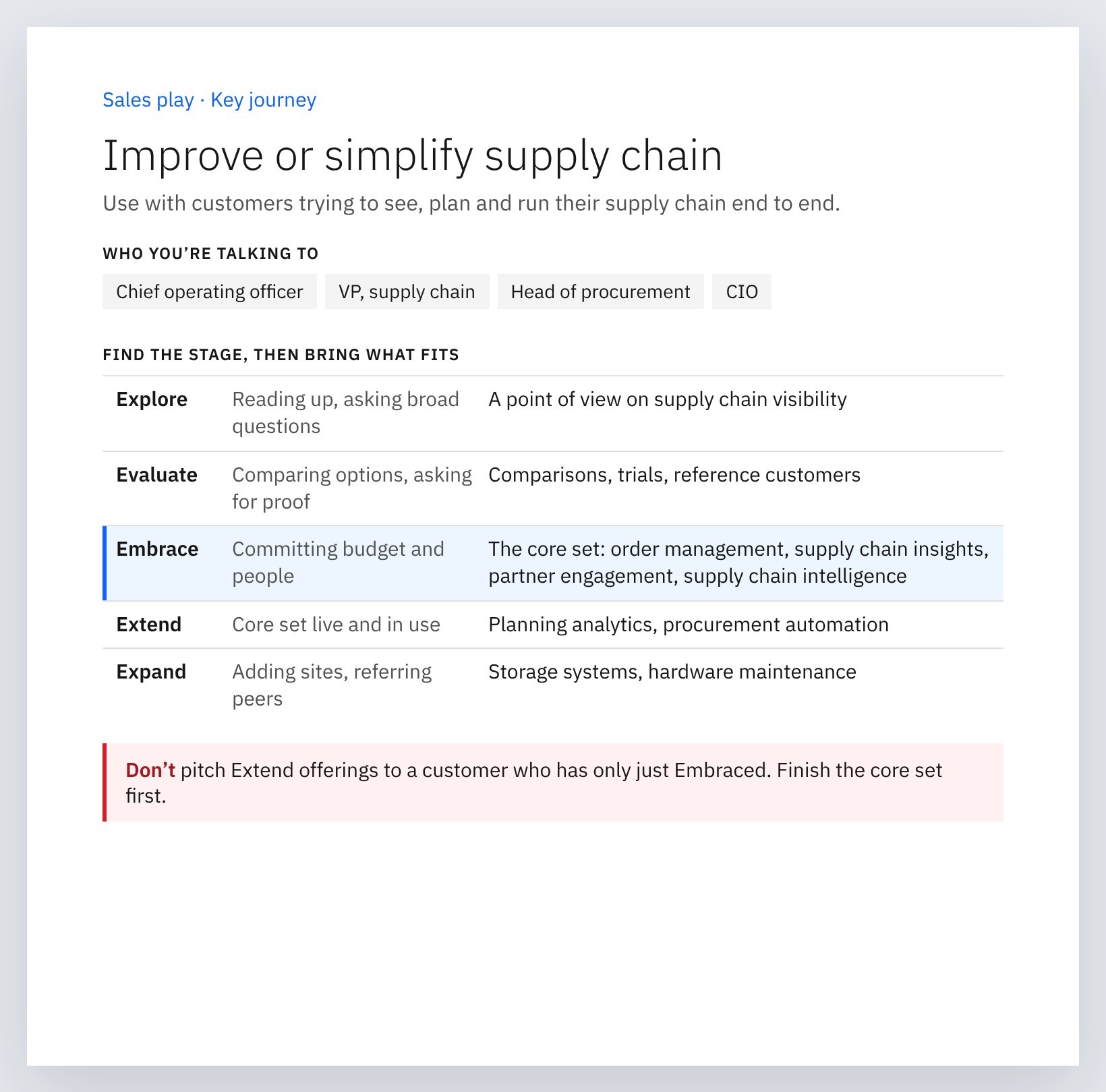
Pitching Extend to a customer who has only just Embraced.
02 · THE MODEL
Turn the research into something any business unit could use
WHAT I DID
I led two data scientists, sharing everything from the stakeholder interviews and research inputs. Together we built a model that recommended the best offering bundles for each journey, and the right order to sell them in for a given audience.
WHY IT MATTERED
It made the framework repeatable. Instead of a one-off study, any sales team could ask what to offer next, to whom and in what sequence, and get an evidence-based answer. The average enterprise deal grew from 1.7 to 4.3 offerings.
INPUTS
Research
Executive interviews, customer data and the voice of the customer through sales and service, mapped to key journeys
MODEL
Purchase patterns
Built by the two data scientists I led: which offerings customers buy together, across business units
OUTPUTS
Bundles and sequence
The best offering bundles per journey, and the right sales order for each audience
IN USE
Sales enablement
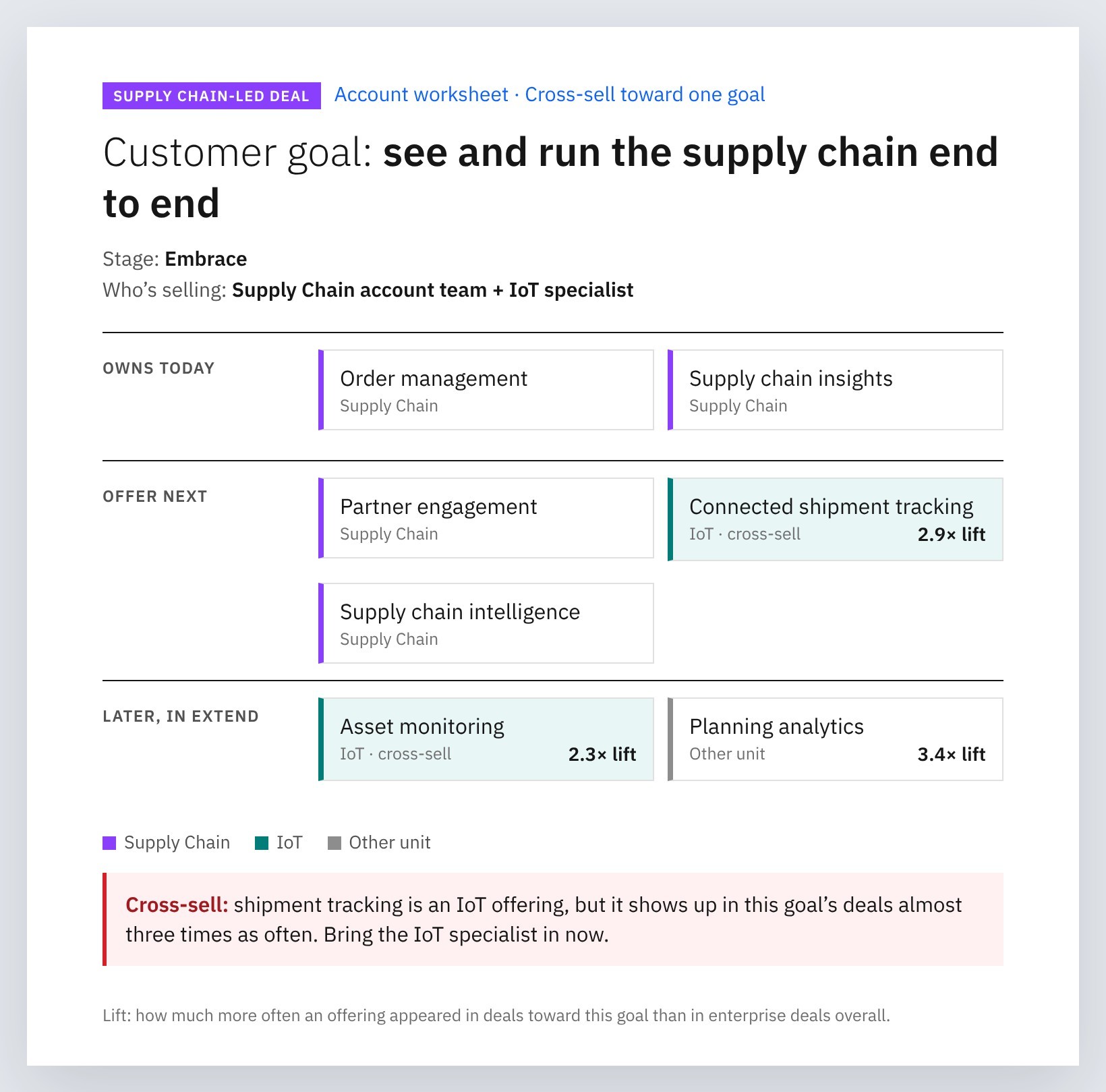
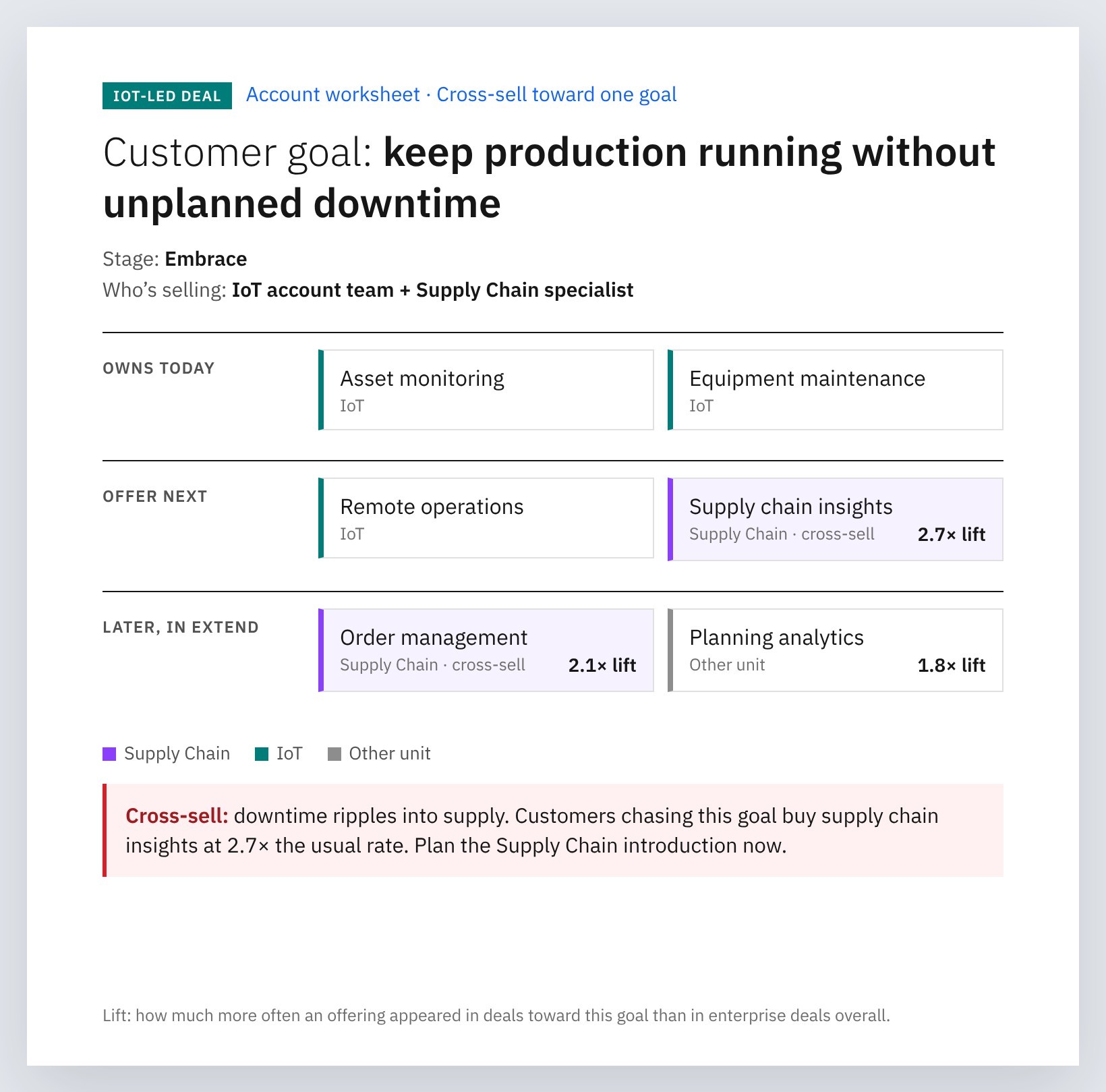
Strategies business units could act on, for cross-selling and up-selling
“I’ve worked with and mentored thousands of employees and students over my 30 year career and I can say confidently that Tricia ranks in the very top one percent. … Tricia’s work routinely stands out in executive reviews for its creativity, attention to detail, service design and analytical rigor, and her confident, well-paced, masterful communication of it.”
FORMER DIRECTOR, IBM GLOBAL DESIGN LEADERSHIP AND ACADEMIC PROGRAMS
03 · THE COALITION
The data made the case. Relationships made it happen.
WHAT I DID
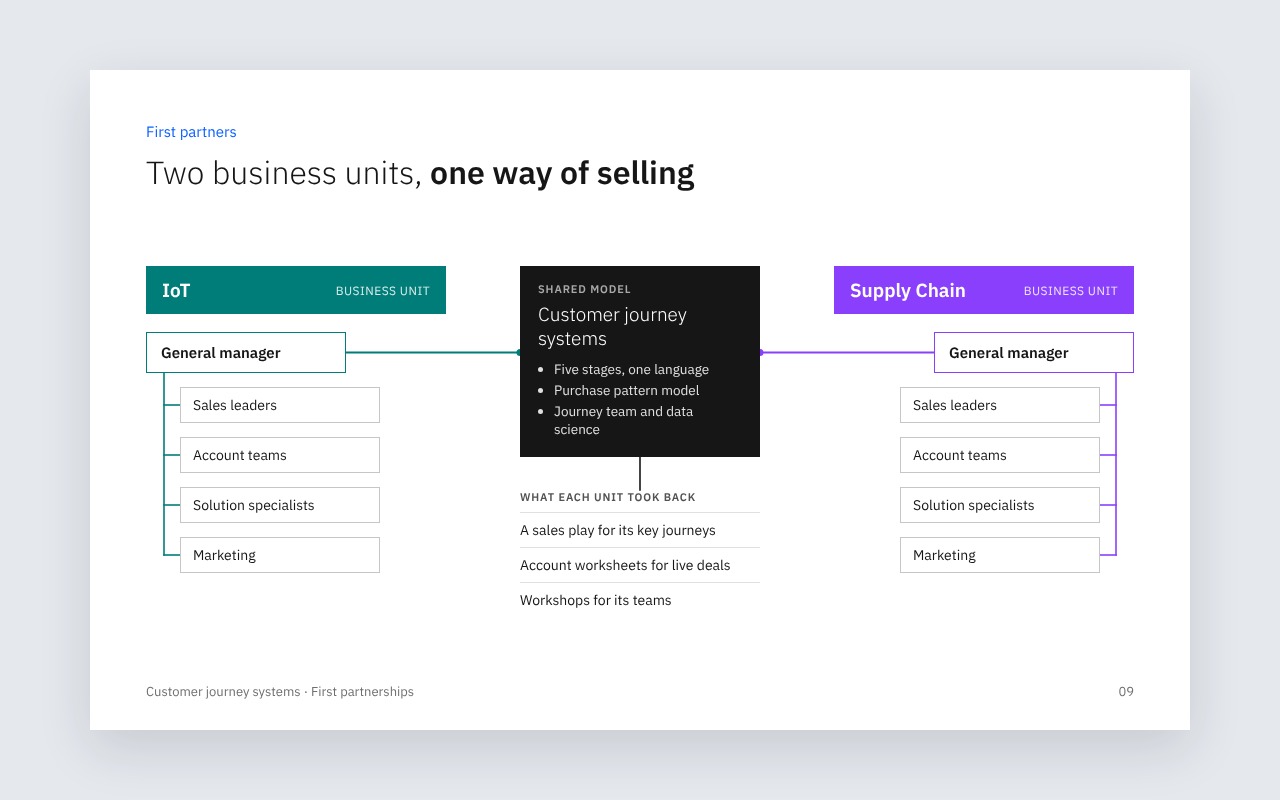
The goal was to broker healthy relationships across business units and build sales collaboration the incentives didn’t reward. That took as much evangelism, narrative and internal marketing as it did rigorous data, and I owned that work: outreach and pitching to general managers, establishing the first partnerships, then working with their teams to keep selling the model’s value from the inside.
01
Pitch
Took the work to general managers across the organization, with a narrative built for each unit’s goals.
02
Partner
Established early partnerships with the IoT and Supply Chain businesses.
03
Prove
Worked inside their teams to show the model’s value in their own deals.
04
Scale
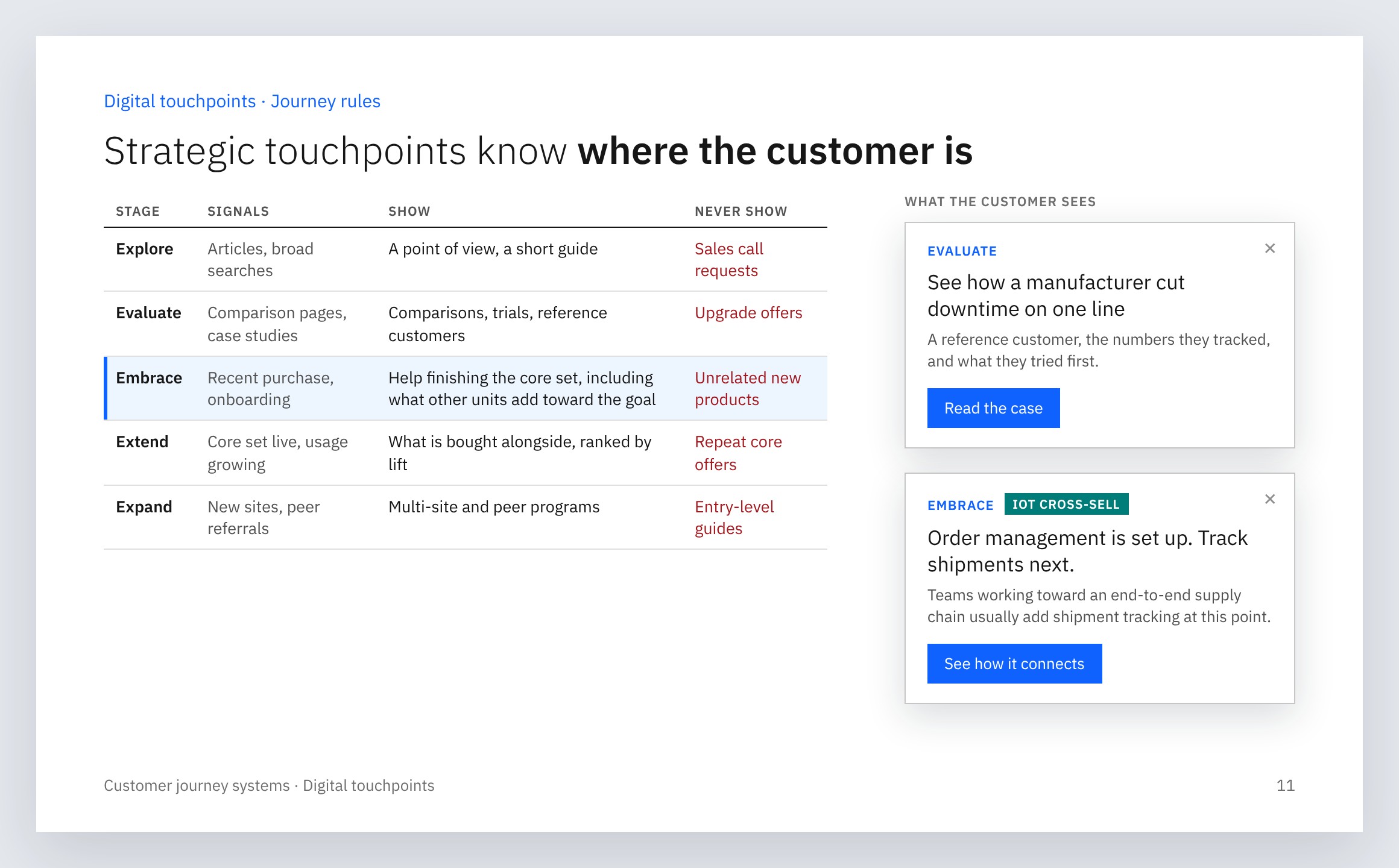
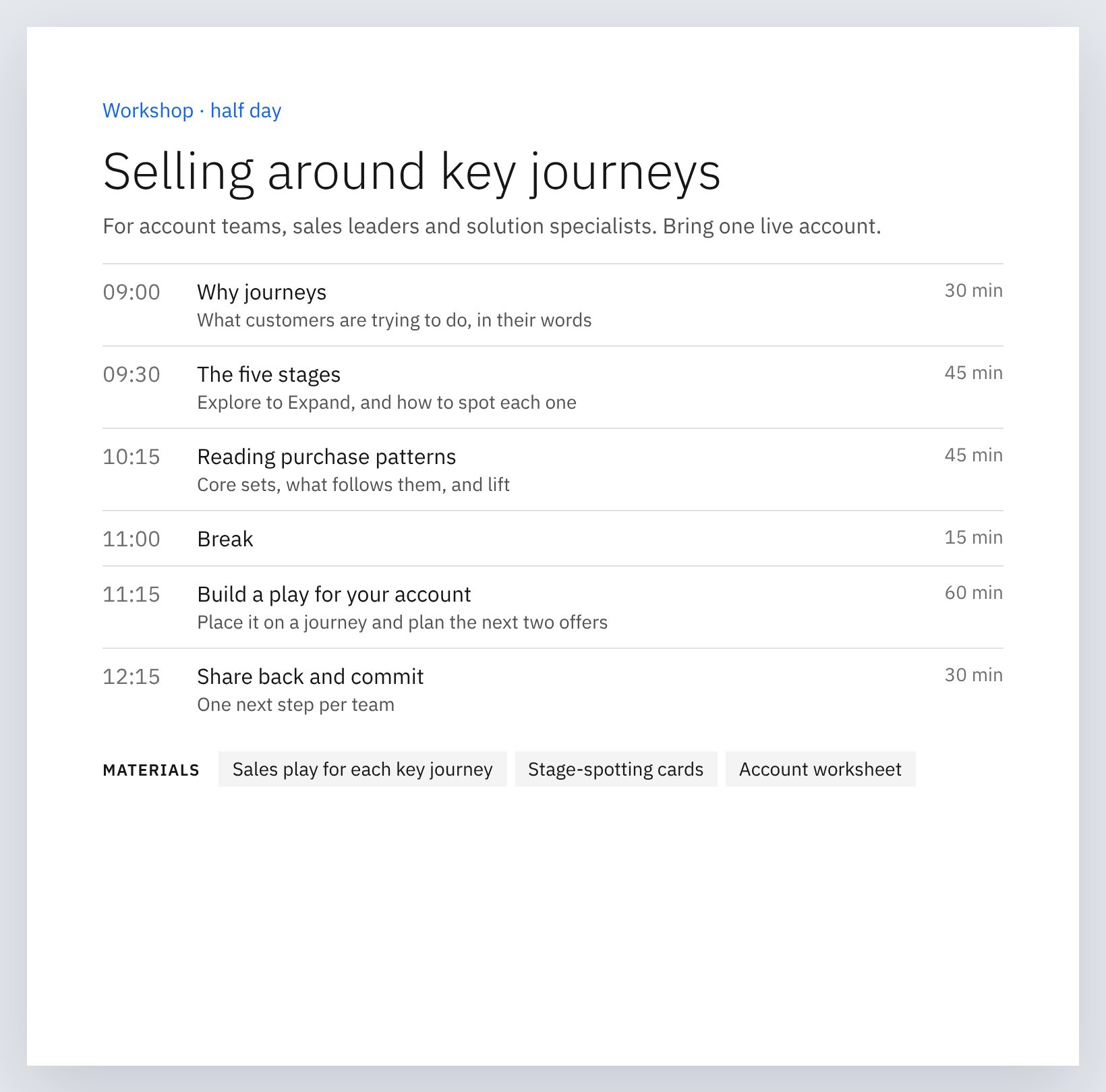
Built the journey logic into strategic digital touchpoints, then spread it through trainings, an internal site and workshops. 400+ trained.
04 · TEAM HEALTH
Help teams see themselves, and communicate their needs to leadership
THE PROBLEM
Teams had no consistent way to assess their own health, and no safe channel to tell senior leadership what they needed. Honest answers about how a team works carry risk. Without protection, teams either say too little to be useful or expose more of their internal dynamics than they should.
WHAT I DID
I designed and built an internal assessment system, deployed across teams, to measure team health, strengths and needs, and to turn candid input into insight leadership could act on. It’s the same premise as my later framework, Development by Design: the conditions people work in shape what they produce, so measure the conditions.
How the system works
The framework: six dimensions, 24 indicators
01
Team alignment
Are we working toward the same outcomes?
- Shared vision and goals
- Strategic clarity
- Priorities and focus
- Understanding of success
02
Roles and ownership
Do people understand their responsibilities?
- Role clarity
- Decision ownership
- Accountability
- Cross-functional boundaries
03
Collaboration and communication
How effectively do we work together?
- Information sharing
- Cross-functional collaboration
- Meeting effectiveness
- Feedback loops
04
Trust and psychological safety
Can people do their best work together?
- Trust
- Constructive disagreement
- Range of lived experience
- Ability to raise concerns
05
Ways of working
Do our processes enable effective delivery?
- Planning and prioritization
- Decision-making speed
- Workflow efficiency
- Tools and processes
06
Growth and sustainability
Can the team continue to evolve and perform?
- Learning and development
- Workload and capacity
- Recognition
- Continuous improvement
The system: eight components, one continuous loop
Not a one-time survey. Each component feeds the next, and the reassessment cadence closes the loop, so teams can see whether the changes they made actually worked.
01
Assessment framework
Six dimensions, 24 indicators
02
Survey questionnaire
What every member reports
03
Interview guide
The why behind the scores
04
Team health scorecard
Where the team stands
05
Diagnostic dashboard
Patterns across dimensions
06
Insight synthesis
What leadership needs to know
07
Action planning framework
What the team will change, with practical strategies
08
Reassessment cadence
Did it work? Start again
↺ Reassessment returns the team to the survey and interviews, measuring change over time.
The hardest problem: candor for the team, discretion for leadership
The system only works if people tell the truth, and they only tell the truth if it’s safe. So the detail stays with the team, and leadership receives a synthesized read: what’s working, what’s getting in the way and where support would help, without exposing who said what.
WHAT THE TEAM SEES
- Their full scorecard across all six dimensions
- The diagnostic dashboard and its patterns
- Interview themes in their own words
- Their action plan and reassessment dates
WHAT LEADERSHIP SEES
“The team generally understands its goals, but struggles to navigate competing priorities. This suggests an opportunity to improve prioritization and decision-making.”
An insight and an opportunity, not a transcript.
From insight to practice: what teams did next
A diagnosis is only useful if teams know what to do next
Every team left with practical design strategies tied to its results, so the action plan became habits rather than intentions. One example: a structured retrospective after each sprint, with questions that point back to the dimensions the team wanted to improve.
SPRINT RETROSPECTIVE · SAMPLE QUESTIONS
ALIGNMENT
“What were we trying to achieve this sprint, and did we all mean the same thing?”
WAYS OF WORKING
“Which decision took longer than it should have, and why?”
COLLABORATION
“Where did information arrive too late, or not at all?”
TRUST AND SAFETY
“What did someone notice but not feel able to say?”
HOW I LED
Start from the customer’s goal, not the product
Framed the work around what customers were trying to reach, so cross-sell became the way to help them get there rather than a sales push.
Evidence executives could own
Brought leaders in from the first interview and paired their view with purchase data, so the model held up in the room and could be reused after it.
Systems over persuasion
Built the logic into key digital touchpoints, sales plays and training, so it kept working in places I would never be.
Safety as a design requirement
Honest input depends on protection, so discretion was built into the system, not added as a policy.